
e-Stamping
Digital vs Physical e-Stamping
Compare digital, eStamp-Physical, traditional physical and State-specific stamping workflows.
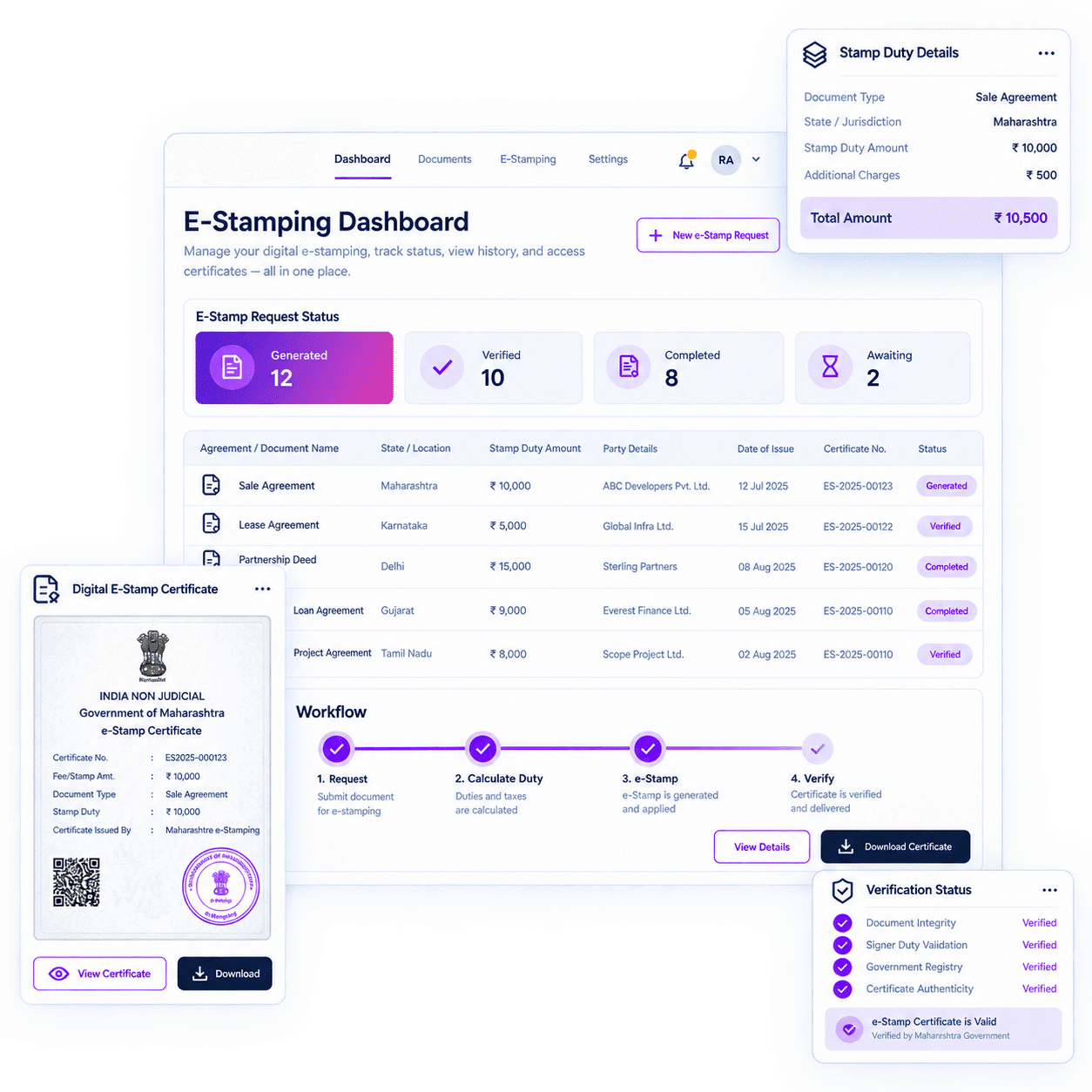
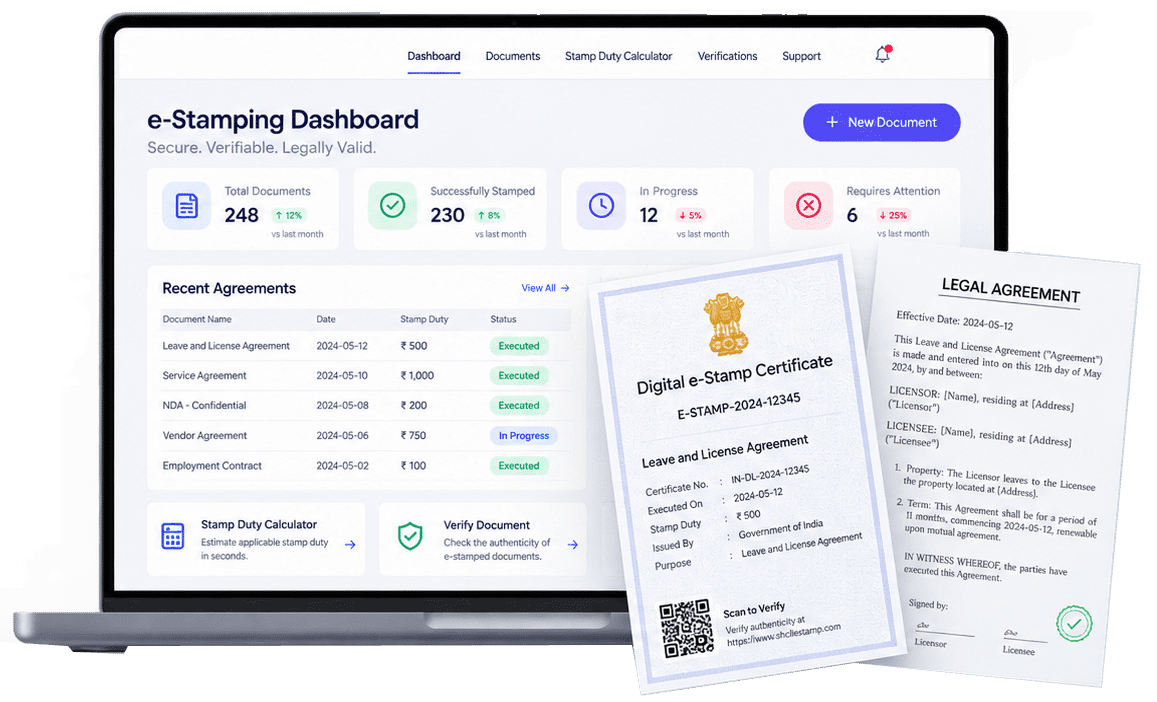
Digital e-Stamping ordinarily generates the certificate electronically. Physical modes require procurement, collection or authorised processing. The available mode depends on the State or Union Territory, transaction and supported infrastructure.
| Question | Digital | eStamp-Physical | Traditional Physical | State-specific Physical |
| Certificate route | Electronic generation | e-Stamp certificate with physical processing | Physical non-judicial stamp paper | Authorised State mechanism |
| Physical procurement | Ordinarily not required | Required | Required | Usually required |
| Scanned copy | Digital certificate is available | Often supports the next step | Depends on document and process | Often supports the next step |
| Indicative source timing | Instant to two business hours | One business day for scanned copy | Five to ten business days | One business day for scanned copy |
| Additional delivery | Usually none | Courier may apply | Courier may apply | Courier may apply |
| Examples in source model | Tamil Nadu, Rajasthan and certain other locations | Delhi, Karnataka and certain other locations | Proposed for some Phase II locations | Maharashtra eSBTR, Haryana eGRAS, Jharkhand NGDRS 2.0 |
Which Mode Should a Business Use?
The decision is not a user preference. The supported route follows the relevant State or Union Territory, document, authorised infrastructure and service availability. A business should therefore begin with jurisdiction and transaction validation rather than selecting “digital” because it appears faster.
Operational Differences
- Digital fulfilment removes ordinary physical procurement but still depends on complete information, approvals and system availability.
- Physical fulfilment adds collection, handling and logistics dependencies.
- A scanned copy can support the next workflow step where the process and document permit it, but physical retention or delivery may still be necessary.
- Traditional physical stamping can be slower because it depends on local stock, denominations and authorised procurement.
- State-specific mechanisms need their own operating instructions and current serviceability check.
RazorSign e-Stamping
What Our Clients Say About Us!
Trusted and Secure
RazorSign has been validated by leading business analyst firms, industry associations, media outlets, partners and customers
FAQs
Is digital e-Stamping legally better than physical stamping?
The relevant question is whether the route is authorised and appropriate for the document and jurisdiction. Digital is not automatically superior as a legal classification.
Can a scanned physical certificate be used to sign?
The operational workflow may use a scanned copy for a supported next step, but legal and evidentiary requirements should be verified.
Why do some States require physical processing?
Stamping infrastructure and authorised processes differ by State and Union Territory.
Are physical modes always slower?
They normally involve more dependencies, but actual timing varies.
Can RazorSign choose the mode automatically?
RazorSign can route according to supported service information, but the customer must verify the jurisdiction, article and duty before submission.
Important Information
This page provides general information about e-Stamping and RazorSign-supported fulfilment workflows. It is not legal, tax, regulatory or professional advice. Stamp duty, document classification, admissibility, execution, registration, cancellation, refund and related requirements depend on the applicable law, State or Union Territory, transaction and document. Customers should obtain advice from qualified professionals and verify current requirements with the relevant government or authorised authority before acting. RazorSign and PracticeLeague facilitate technology and fulfilment workflows and do not independently issue government e-Stamp certificates or act as a government authority.